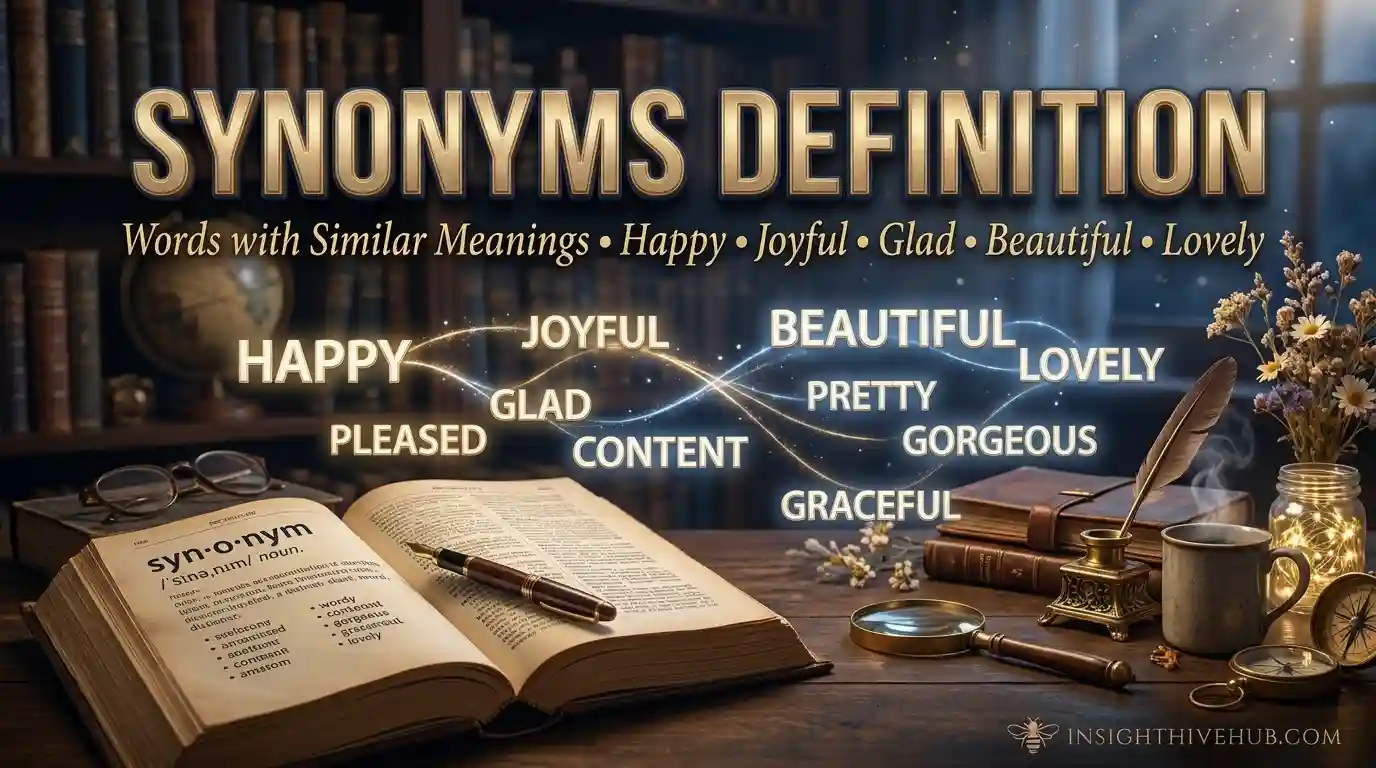
Have you ever used the same word again and again while writing? Learning new words can make your English better and more interesting. This is where synonyms help. The synonyms definition is simple: synonyms are words that have the same or nearly the same meaning as another word. For example, happy and joyful have similar meanings. Both words show a feeling of joy. Learning the synonyms definition is useful for students, bloggers, content writers, and anyone who wants to improve their English. It helps you choose better words, avoid repetition, and make your writing clear. In this guide, you will learn 50 related words with simple meanings and examples.
1. Similar Words
Meaning: Similar words have almost the same meaning as other words.
Examples:
- Happy and glad are similar words.
- These two words have similar meanings.
2. Equivalent Words
Meaning: Equivalent words have the same meaning or value in a certain context.
Examples:
- These two terms are equivalent.
- We used equivalent words in the sentence.
3. Alternatives
Meaning: Alternatives are other words or choices you can use.
Examples:
- Can you suggest an alternative to happy?
- I need an alternative word for good.
4. Near-Synonyms
Meaning: Near-synonyms are words with almost the same meaning.
Examples:
- Big and large are near-synonyms.
- These words are close in meaning.
5. Related Words
Meaning: Related words share a connection in meaning or use.
Examples:
- Kind and caring are related words.
- We studied related words in class.
6. Similar Expressions
Meaning: Similar expressions are different ways to say almost the same thing.
Examples:
- Both expressions show love.
- Try using similar expressions in your essay.
7. Word Substitutes
Meaning: Word substitutes are words used in place of other words.
Examples:
- Use a word substitute to avoid repetition.
- She found a good substitute for nice.
8. Paraphrases
Meaning: Paraphrases express the same idea using different words.
Examples:
- Please paraphrase this short sentence.
- His paraphrase kept the same meaning.
9. Replacements
Meaning: Replacements are words or things used instead of others.
Examples:
- We need a replacement for this word.
- She found a replacement for beautiful.
10. Alternatives in Meaning
Meaning: These are different words that express a similar idea.
Examples:
- Find alternatives in meaning for the word smart.
- The teacher gave us several alternatives in meaning.
11. Linguistic Equivalents
Meaning: Linguistic equivalents are words or phrases with similar meanings in language.
Examples:
- We compared the linguistic equivalents.
- The two terms are linguistic equivalents in this context.
12. Semantic Equivalents
Meaning: Semantic equivalents are words that share the same meaning in a particular context.
Examples:
- These words are semantic equivalents.
- The writer searched for semantic equivalents.
13. Word Variations
Meaning: Word variations are different forms or choices of words.
Examples:
- Try using word variations in your writing.
- The list gives several word variations.
14. Lexical Alternatives
Meaning: Lexical alternatives are other words that can express a similar meaning.
Examples:
- The dictionary offers lexical alternatives.
- Writers often look for lexical alternatives.
15. Expressions
Meaning: Expressions are words or groups of words used to share an idea.
Examples:
- She used a kind expression.
- This expression has a similar meaning.
16. Terms
Meaning: Terms are words used to describe a person, thing, or idea.
Examples:
- Learn these terms before the test.
- Both terms are used in English.
17. Vocabulary
Meaning: Vocabulary is the collection of words a person knows or uses.
Examples:
- Reading helps build your vocabulary.
- I want to improve my English vocabulary.
18. Word Choices
Meaning: Word choices are the words you select when speaking or writing.
Examples:
- Good word choices make writing clear.
- Think about your word choices before submitting your essay.
19. Lexical Matches
Meaning: Lexical matches are words that have similar meanings or uses.
Examples:
- The teacher found lexical matches.
- These two words are lexical matches in this sentence.
20. Semantic Matches
Meaning: Semantic matches are words that share a similar meaning.
Examples:
- We found semantic matches in the text.
- These words are semantic matches.
21. Corresponding Words
Meaning: Corresponding words are words that match each other in meaning or use.
Examples:
- Find the corresponding word in the list.
- These are corresponding words in both sentences.
22. Matching Terms
Meaning: Matching terms are words that have a similar meaning or purpose.
Examples:
- The student selected matching terms.
- Both matching terms describe the same idea.
23. Comparable Words
Meaning: Comparable words are words that can be compared because they share similar meanings.
Examples:
- These are comparable words.
- We learned comparable words in our lesson.
24. Cognate Words
Meaning: Cognate words have a shared origin and often look or sound alike.
Examples:
- English and Spanish have some cognate words.
- The teacher explained these cognate words.
25. Related Terms
Meaning: Related terms are words connected by meaning or subject.
Examples:
- Learn these related terms together.
- The article explains several related terms.
26. Word Pairs
Meaning: Word pairs are two words that are often studied or used together.
Examples:
- Happy and joyful make a useful word pair.
- We learned new word pairs today.
27. Semantic Relations
Meaning: Semantic relations are connections between the meanings of words.
Examples:
- Students can study semantic relations.
- The lesson explains semantic relations between words.
28. Word Associations
Meaning: Word associations are connections people make between words and ideas.
Examples:
- Love brings many word associations to mind.
- The teacher asked us to make word associations.
29. Meaning-Based Alternatives
Meaning: These are other words chosen because they share a similar meaning.
Examples:
- Find meaning-based alternatives for strong.
- These meaning-based alternatives fit the sentence.
30. Equivalent Expressions
Meaning: Equivalent expressions communicate the same idea in different ways.
Examples:
- Both phrases are equivalent expressions.
- Use equivalent expressions in your writing.
31. Parallel Words
Meaning: Parallel words are words that have similar meanings or functions.
Examples:
- The writer used parallel words in the article.
- These parallel words describe the same feeling.
32. Alternative Terms
Meaning: Alternative terms are other words used to describe the same thing.
Examples:
- What are alternative terms for help?
- The book provides alternative terms.
33. Similar Terms
Meaning: Similar terms are words that have close meanings.
Examples:
- These similar terms are easy to learn.
- The teacher explained similar terms.
34. Substitute Expressions
Meaning: Substitute expressions are phrases used instead of other phrases.
Examples:
- Use substitute expressions in your email.
- She chose a substitute expression for the original phrase.
35. Word Equivalents
Meaning: Word equivalents are words with the same or nearly the same meaning.
Examples:
- The dictionary lists word equivalents.
- Find two word equivalents for beautiful.
36. Semantic Alternatives
Meaning: Semantic alternatives are words that offer different ways to express a similar idea.
Examples:
- Writers use semantic alternatives to improve their work.
- The lesson includes semantic alternatives.
37. Lexical Substitutes
Meaning: Lexical substitutes are words used in place of other words.
Examples:
- The writer searched for lexical substitutes.
- Lexical substitutes can reduce repeated words.
38. Equivalent Terms
Meaning: Equivalent terms have the same meaning in a specific situation.
Examples:
- These are equivalent terms in this field.
- The teacher explained the equivalent terms.
39. Meaningful Alternatives
Meaning: Meaningful alternatives are other words that express a clear and related idea.
Examples:
- Choose meaningful alternatives for your essay.
- The writer added meaningful alternatives to the article.
40. Word Comparisons
Meaning: Word comparisons show how two or more words are alike or different.
Examples:
- We made word comparisons in class.
- Word comparisons help us understand meaning.
41. Semantic Variants
Meaning: Semantic variants are different words or forms with related meanings.
Examples:
- The lesson covers semantic variants.
- These semantic variants express a close idea.
42. Lexical Variants
Meaning: Lexical variants are different words used to express similar ideas.
Examples:
- The writer explored lexical variants.
- These lexical variants fit the same topic.
43. Meaning Alternatives
Meaning: Meaning alternatives are different words that can express a similar idea.
Examples:
- Find meaning alternatives for the word calm.
- The list offers useful meaning alternatives.
44. Word Options
Meaning: Word options are different words you can choose from.
Examples:
- I need more word options for my essay.
- The dictionary gives several word options.
45. Similar Vocabulary
Meaning: Similar vocabulary includes words that have close meanings.
Examples:
- Learn similar vocabulary to improve your English.
- The lesson includes similar vocabulary for beginners.
46. Related Vocabulary
Meaning: Related vocabulary includes words connected by meaning or topic.
Examples:
- We studied related vocabulary about nature.
- Reading helps you learn related vocabulary.
47. Equivalent Vocabulary
Meaning: Equivalent vocabulary includes words that express the same or a similar idea.
Examples:
- The book teaches equivalent vocabulary.
- Students practiced equivalent vocabulary today.
48. Word Replacements
Meaning: Word replacements are other words used instead of the original words.
Examples:
- Find word replacements for the word nice.
- Word replacements can make your writing more interesting.
49. Meaningful Substitutes
Meaning: Meaningful substitutes are words that can replace other words while keeping a similar idea.
Examples:
- Choose meaningful substitutes for your article.
- She found meaningful substitutes for common words.
50. Alternative Expressions
Meaning: Alternative expressions are different phrases that communicate a similar message.
Examples:
- Use alternative expressions in your daily conversations.
- The teacher shared alternative expressions with the class.
Conclusion
Learning synonyms helps you become a better writer and speaker. It makes your writing clear and helps you avoid using the same words again and again. Bloggers and content writers can use synonyms to make their articles more natural. Students can also improve their essays and vocabulary. Start practicing these words in emails, essays, and daily conversations. Small steps can make your English stronger every day.

I’m Mafia Noor, a language enthusiast and writer with 5 years of experience in vocabulary, synonyms, word meanings, and English communication. At InsightHiveHub, I create simple and practical content to help readers find better words, understand meanings, and communicate with confidence.