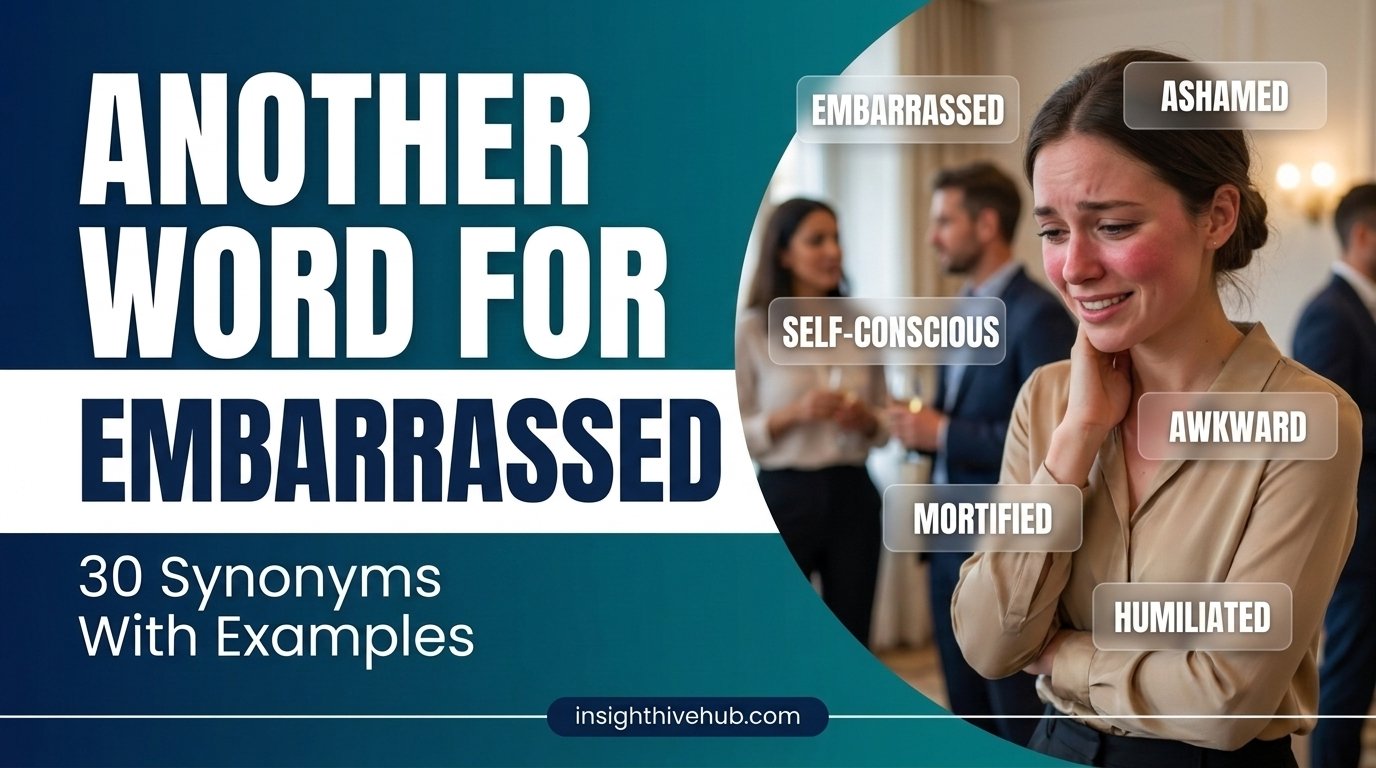
If you need another word for embarrassed, the closest everyday alternatives are ashamed, self-conscious, uncomfortable, awkward, and mortified. Each word expresses a slightly different feeling. For example, self-conscious describes worry about how others see you, while mortified suggests intense embarrassment.
The best synonym depends on the situation. You might feel awkward after making a social mistake, ashamed after doing something wrong, or humiliated when others make you feel small. Understanding these differences helps you choose a word that expresses the right feeling.
Quick list: Ashamed, self-conscious, awkward, uncomfortable, mortified, humiliated, abashed, flustered, sheepish, and chagrined.
This guide examines 30 alternatives to embarrassed, including their meanings, pronunciations in IPA, usage notes, natural examples, common word partners, and related expressions. It also explains which words fit casual conversations, formal writing, and stronger emotional situations.
At a Glance: Embarrassed Synonyms and Related Alternatives
| Alternative | Part of Speech | Meaning | Register / Tone | Ideal Context |
| Ashamed | Adjective | Feeling shame about an action | Neutral, serious | A mistake or wrongdoing |
| Self-conscious | Adjective | Worried about how others see you | Neutral | Social situations |
| Awkward | Adjective | Feeling uncomfortable or out of place | Casual, neutral | Social mistakes |
| Uncomfortable | Adjective | Feeling uneasy or ill at ease | Neutral | Difficult interactions |
| Mortified | Adjective | Extremely embarrassed | Strong, expressive | A major social mistake |
| Humiliated | Adjective | Made to feel deeply ashamed or inferior | Strong, serious | Public embarrassment |
| Abashed | Adjective | Embarrassed and unsure of yourself | Formal, literary | Unexpected attention |
| Flustered | Adjective | Confused or upset and unable to act calmly | Neutral | Sudden pressure |
| Sheepish | Adjective | Embarrassed about looking foolish or doing wrong | Informal, friendly | Minor mistakes |
| Chagrined | Adjective | Disappointed or annoyed by an embarrassing setback | Formal | Failed plans or errors |
These distinctions are supported by the synonym groupings in Collins and Cambridge dictionaries.
Collins English Thesaurus
+1
Which Word Should You Use?
| If you want to… | Use | Why |
| Describe ordinary embarrassment | Embarrassed or awkward | Both fit everyday social situations |
| Show that you regret doing something wrong | Ashamed | It highlights a sense of shame |
| Describe intense embarrassment | Mortified | It conveys a very strong reaction |
| Explain embarrassment about appearance | Self-conscious | It focuses on awareness of others’ opinions |
| Describe a person who made a silly mistake | Sheepish | It often suggests mild, almost humorous embarrassment |
| Describe public shame caused by others | Humiliated | It emphasizes being lowered or exposed in front of others |
| Describe embarrassment mixed with disappointment | Chagrined | It often involves frustration about an unwanted result |
| Describe losing your composure | Flustered | It highlights confusion, nervousness, or agitation |
Exploring the Multiple Meanings of “Embarrassed”
The adjective embarrassed can describe several related feelings. It does not always mean that someone believes they have done something wrong.
1. Feeling Awkward in a Social Situation
- Meaning: Feeling uncomfortable because of something unexpected, unusual, or socially difficult.
- Explanation: This is one of the most common senses of embarrassed. It can happen when you forget someone’s name, trip in public, or receive unexpected attention. Unlike ashamed, it does not require wrongdoing.
- Example: I felt embarrassed when I waved at someone who was waving at the person behind me.
2. Feeling Shame About Your Own Behavior
- Meaning: Feeling bad about something you did, said, or failed to do.
- Explanation: In this sense, embarrassed overlaps with ashamed. However, ashamed often suggests a deeper moral concern or regret, while embarrassed may focus more on how the action looks to others.
- Example: He was embarrassed by the rude comment he made during dinner.
3. Feeling Exposed or Judged by Others
- Meaning: Feeling uncomfortable because you believe people are noticing or judging you.
- Explanation: This sense often overlaps with self-conscious. It may relate to appearance, public speaking, clothing, or being the center of attention.
- Example: She felt embarrassed when everyone looked at her new haircut.
4. Feeling Deeply Humiliated
- Meaning: Experiencing intense embarrassment, often because of public criticism, exposure, or ridicule.
- Explanation: Mortified and humiliated can express stronger feelings than ordinary embarrassment. Humiliated especially suggests that someone’s dignity has been damaged or that another person has treated them as inferior.
- Example: He was humiliated when his manager criticized him in front of the whole team.
5. Feeling Confused or Losing Composure
- Meaning: Feeling nervous, unsettled, or unsure how to respond.
- Explanation: When embarrassment makes it hard to think clearly or speak smoothly, flustered may be a better choice. It describes the person’s reaction rather than the embarrassing event itself.
- Example: I became flustered when the teacher asked me a question I could not answer.
Sources: Collins English Thesaurus: Embarrassed; Cambridge English Thesaurus: Embarrassed.
Analyzing 30 Embarrassed Alternatives in Detail
Some words below are direct synonyms of embarrassed. Others are related alternatives that fit only certain situations, so their usage notes explain the difference.
Group 1: Everyday Synonyms
1. Ashamed
IPA: US /əˈʃeɪmd/ · UK /əˈʃeɪmd/
Definition: Feeling shame, regret, or disgrace because of something you have done or something associated with you.
- Usage: Use ashamed when embarrassment involves regret or a sense of wrongdoing. It is stronger and more morally focused than ordinary social awkwardness.
- Example: She felt ashamed after laughing at her friend’s mistake.
2. Awkward
IPA: US /ˈɔːkwərd/ · UK /ˈɔːkwəd/
Definition: Feeling uncomfortable, uneasy, or unsure how to behave in a situation.
- Usage: Awkward is a common alternative for mild social embarrassment. It can also describe a situation itself, rather than a person’s feelings.
- Example: It was awkward when neither of us remembered the other person’s name.
3. Uncomfortable
IPA: US /ʌnˈkʌmftərbəl/ · UK /ʌnˈkʌmftəbəl/
Definition: Experiencing physical or emotional unease.
- Usage: This is a broader alternative, not an exact synonym in every context. Use it when embarrassment makes someone feel uneasy, especially during a difficult conversation.
- Example: I felt uncomfortable when my coworkers discussed my private life.
4. Self-conscious
IPA: US /ˌself ˈkɑːnʃəs/ · UK /ˌself ˈkɒnʃəs/
Definition: Too aware of yourself and worried about how others see you.
- Usage: Choose self-conscious when embarrassment comes from concern about appearance, behavior, or other people’s opinions. It can describe a lasting tendency as well as a temporary feeling.
- Example: He felt self-conscious about speaking English in front of the class.
5. Sheepish
IPA: US /ˈʃiːpɪʃ/ · UK /ˈʃiːpɪʃ/
Definition: Embarrassed because you have done something foolish or wrong.
- Usage: Sheepish often describes mild embarrassment mixed with guilt or an awareness of looking silly. It commonly appears with smile, grin, and look.
- Example: He gave me a sheepish grin after spilling coffee on the table.
Group 2: Stronger Feelings of Embarrassment
6. Mortified
IPA: US /ˈmɔːrtɪfaɪd/ · UK /ˈmɔːtɪfaɪd/
Definition: Extremely embarrassed or deeply ashamed.
- Usage: Use mortified when an incident causes intense embarrassment. It is more forceful than embarrassed and often appears in personal stories.
- Example: I was mortified when I called my new teacher by the wrong name.
7. Humiliated
IPA: US /hjuːˈmɪlieɪtɪd/ · UK /hjuːˈmɪlieɪtɪd/
Definition: Made to feel ashamed, foolish, or inferior.
- Usage: Humiliated often implies that another person or a public event has damaged someone’s dignity. It is not interchangeable with every mild form of embarrassment.
- Example: She felt humiliated when her private message was read aloud.
8. Abashed
IPA: US /əˈbæʃt/ · UK /əˈbæʃt/
Definition: Embarrassed, ashamed, or made less confident.
- Usage: This is a somewhat formal or literary alternative. It often describes someone who becomes quiet or loses confidence after praise, criticism, or unexpected attention.
- Example: He looked abashed when everyone praised his work.
9. Shamefaced
IPA: US /ˈʃeɪmfeɪst/ · UK /ˈʃeɪmfeɪst/
Definition: Showing embarrassment or shame, especially after doing something wrong.
- Usage: Shamefaced often describes someone’s expression or appearance. It has a more descriptive tone than the everyday word embarrassed.
- Example: The shamefaced boy apologized for breaking the window.
10. Chagrined
IPA: US /ʃəˈɡrɪnd/ · UK /ˈʃæɡrɪnd/
Definition: Disappointed or annoyed because something has gone wrong.
- Usage: Chagrined is a formal alternative when embarrassment comes with frustration, regret, or wounded pride. It is related to embarrassment but does not always mean embarrassment by itself.
- Example: She was chagrined to discover that she had sent the draft to the wrong client.
Group 3: Nervousness and Loss of Composure
11. Flustered
IPA: US /ˈflʌstərd/ · UK /ˈflʌstəd/
Definition: Nervous, confused, or upset and unable to think or act calmly.
- Usage: Choose flustered when embarrassment makes someone lose their composure. It emphasizes the immediate reaction, not necessarily shame.
- Example: I became flustered when everyone started asking questions at once.
12. Disconcerted
IPA: US /ˌdɪskənˈsɜːrtɪd/ · UK /ˌdɪskənˈsɜːtɪd/
Definition: Disturbed, unsettled, or confused by something unexpected.
- Usage: This is a more formal alternative. It fits embarrassment caused by a surprising question or an unexpected event, but it can also describe general unease.
- Example: He seemed disconcerted when the interviewer mentioned his earlier mistake.
13. Discomfited
IPA: US /dɪsˈkʌmfɪtɪd/ · UK /dɪsˈkʌmfɪtɪd/
Definition: Made uncomfortable, confused, or unsettled.
- Usage: Discomfited is a formal, less common word. It can replace embarrassed when someone has been put off balance, but it may also describe discomfort without shame.
- Example: The unexpected criticism left the speaker discomfited.
14. Rattled
IPA: US /ˈrætəld/ · UK /ˈrætəld/
Definition: Nervous, upset, or confused, especially after a shock or setback.
- Usage: This informal alternative is useful when embarrassment leaves someone shaken or unable to respond confidently. It does not always imply shame.
- Example: He was rattled after forgetting his opening lines on stage.
15. Nonplussed
IPA: US /ˌnɑːnˈplʌst/ · UK /ˌnɒnˈplʌst/
Definition: Surprised and confused, often unsure how to respond.
- Usage: Nonplussed is related to embarrassment when an unexpected event leaves someone speechless. It means puzzled or taken aback, not necessarily ashamed.
- Example: She looked nonplussed when the audience began asking questions she had not prepared for.
Group 4: Shame, Regret, and Disappointment
16. Guilty
IPA: US /ˈɡɪlti/ · UK /ˈɡɪlti/
Definition: Feeling that you have done something wrong or are responsible for a problem.
- Usage: Guilty is a related alternative when embarrassment comes from responsibility or regret. It is not a direct substitute when someone is embarrassed by an innocent social mistake.
- Example: I felt guilty and embarrassed after forgetting my friend’s birthday.
17. Remorseful
IPA: US /rɪˈmɔːrsfəl/ · UK /rɪˈmɔːsfəl/
Definition: Feeling deep regret for having done something wrong.
- Usage: This word emphasizes sincere regret rather than social discomfort. Use it when the embarrassment is tied to a serious mistake or harm caused to someone.
- Example: He was remorseful after realizing how much his words had hurt her.
18. Crestfallen
IPA: US /ˈkrestˌfɔːlən/ · UK /ˈkrestˌfɔːlən/
Definition: Sad and disappointed because something has gone wrong.
- Usage: Crestfallen is a related alternative when embarrassment leaves someone visibly disappointed or dejected. It does not necessarily mean shame.
- Example: She looked crestfallen after giving the wrong answer in the competition.
19. Humbled
IPA: US /ˈhʌmbəld/ · UK /ˈhʌmbəld/
Definition: Made less proud or more aware of your limitations.
- Usage: Humbled can describe an embarrassing experience that makes someone more modest. It is not an exact synonym because being humbled can also be a positive experience.
- Example: He felt humbled when his team kindly helped him correct his mistake.
20. Put out
IPA: US /pʊt aʊt/ · UK /pʊt aʊt/
Definition: Annoyed, inconvenienced, or displeased.
- Usage: This informal expression is a contextual alternative only when embarrassment also involves annoyance or discomfort. It does not mean embarrassed on its own.
- Example: She was put out when her colleague pointed out the error during the meeting.
Group 5: Visible Signs and Social Discomfort
21. Red-faced
IPA: US /ˌred ˈfeɪst/ · UK /ˌred ˈfeɪst/
Definition: Having a red face, often because of embarrassment, anger, or exertion.
- Usage: Red-faced describes a visible sign of embarrassment, not the feeling itself. It is especially useful in storytelling.
- Example: He stood red-faced after realizing that his microphone was still on.
22. Blushing
IPA: US /ˈblʌʃɪŋ/ · UK /ˈblʌʃɪŋ/
Definition: Becoming red in the face because of embarrassment, shyness, or another strong emotion.
- Usage: This describes a physical reaction that may accompany embarrassment. Not everyone who is embarrassed blushes, and people may blush for other reasons.
- Example: She was blushing after her friends complimented her singing.
23. Bashful
IPA: US /ˈbæʃfəl/ · UK /ˈbæʃfəl/
Definition: Shy or easily embarrassed, especially around other people.
- Usage: Bashful usually describes shyness or a tendency to feel embarrassed rather than a single embarrassing event. It often sounds gentle or affectionate.
- Example: The bashful child hid behind his mother when guests arrived.
24. Uneasy
IPA: US /ʌnˈiːzi/ · UK /ʌnˈiːzi/
Definition: Worried, uncomfortable, or uncertain.
- Usage: Uneasy is a broad related alternative. Use it when someone feels uncomfortable in an embarrassing situation, especially if they are also worried about what may happen.
- Example: I felt uneasy when the conversation turned to my personal life.
25. Ill at ease
IPA: US /ˌɪl ət ˈiːz/ · UK /ˌɪl ət ˈiːz/
Definition: Uncomfortable, nervous, or not relaxed in a situation.
- Usage: This established expression is a natural alternative for social embarrassment or nervousness. It is descriptive and slightly more formal than awkward.
- Example: He felt ill at ease when he entered the crowded room alone.
Group 6: Context-Specific and Expressive Alternatives
26. Disgraced
IPA: US /dɪsˈɡreɪst/ · UK /dɪsˈɡreɪst/
Definition: Having lost respect or honor because of wrongdoing or a serious failure.
- Usage: Disgraced is much stronger and more lasting than embarrassed. Use it when a person’s reputation or standing has suffered, not for a small social mistake.
- Example: The official resigned after the scandal left him disgraced.
27. Flummoxed
IPA: US /ˈflʌməkst/ · UK /ˈflʌməkst/
Definition: Confused or puzzled and unsure what to do.
- Usage: This informal word can fit an embarrassing moment when someone is caught off guard. However, it emphasizes confusion rather than shame.
- Example: I was flummoxed when the host asked me to explain a topic I barely knew.
28. Fazed
IPA: US /feɪzd/ · UK /feɪzd/
Definition: Disturbed, upset, or unsettled by something.
- Usage: Fazed is often used in negative statements such as not fazed. It can describe someone’s reaction to an embarrassing event but is not a direct synonym for feeling embarrassed.
- Example: She seemed unfazed by the small mistake and carried on with her speech.
29. Shy
IPA: US /ʃaɪ/ · UK /ʃaɪ/
Definition: Nervous or uncomfortable around other people or in unfamiliar situations.
- Usage: Shy is a related alternative when embarrassment comes from social hesitation. It often describes a person’s general manner, not just a temporary feeling.
- Example: He felt shy when he had to introduce himself to the new class.
30. Taken aback
IPA: US /ˌteɪkən əˈbæk/ · UK /ˌteɪkən əˈbæk/
Definition: Surprised or shocked by something unexpected.
- Usage: This established expression is suitable when an embarrassing remark or event catches someone off guard. It describes surprise, which may or may not lead to embarrassment.
- Example: I was taken aback when my friend mentioned my mistake in front of everyone.
Sources: Collins English Thesaurus: Embarrassed; Cambridge English Thesaurus: Embarrassed; Oxford Learner’s Dictionaries: Sheepish.
Embarrassed vs. Ashamed vs. Humiliated
These three words overlap, but they do not express the same degree or kind of feeling.
| Word | Main Focus | Typical Situation | Example |
| Embarrassed | Social discomfort or awkwardness | Making a small mistake in public | I was embarrassed when I forgot his name. |
| Ashamed | Regret or a sense of wrongdoing | Saying something hurtful | She was ashamed of her behavior. |
| Humiliated | Loss of dignity or being made to feel inferior | Being mocked in front of others | He felt humiliated when his boss insulted him publicly. |
| Mortified | Very intense embarrassment | A highly awkward or upsetting mistake | I was mortified when I sent the message to the wrong person. |
| Self-conscious | Concern about how others see you | Speaking before a crowd | She felt self-conscious about her appearance. |
The key difference is the source of the feeling. You can be embarrassed without doing anything wrong, ashamed because you believe you acted badly, or humiliated because someone treated you in a degrading way. Mortified emphasizes the intensity of embarrassment, while self-conscious focuses on awareness of other people’s attention or judgment.
Collins English Thesaurus
+1
Embarrassed and Opposite/Paired Word Pairs
| Word | Paired Word | Note |
| Embarrassed | Unembarrassed | Feeling awkward versus not feeling awkward |
| Ashamed | Unashamed | Feeling shame versus feeling no shame |
| Humiliated | Respected | Being degraded versus being treated with respect |
| Self-conscious | Confident | Worrying about others’ opinions versus feeling assured |
| Shy | Outgoing | Reserved in social settings versus sociable |
| Awkward | At ease | Feeling socially uncomfortable versus feeling relaxed |
| Sheepish | Unapologetic | Looking embarrassed or regretful versus showing no apology |
| Mortified | Relieved | Experiencing intense embarrassment versus feeling that a worry has passed |
These are natural contrasts, not all strict dictionary antonyms. For example, confident is a useful contrast to self-conscious, but a confident person can still feel embarrassed. Likewise, relieved describes a different emotional state rather than the exact opposite of mortified.
Sources: Collins English Thesaurus: Sheepish; Cambridge English Thesaurus: Embarrassed.
Common Word Partners of “Embarrassed”
Collocations are words that commonly appear together. Learning them helps you sound more natural when speaking or writing about embarrassment.
| Pattern | Common Partners | Example |
| Intensifier + embarrassed | deeply, extremely, terribly, slightly | I was deeply embarrassed by my mistake. |
| Embarrassed + preposition | about, by, at, over | She was embarrassed about her answer. |
| Feel + adjective | feel embarrassed, feel awkward, feel ashamed | He felt awkward during the introduction. |
| Embarrassed + infinitive | embarrassed to ask, embarrassed to admit | I was embarrassed to ask for help. |
| Cause of embarrassment | mistake, incident, situation, comment | The incident caused considerable embarrassment. |
| Facial expression | embarrassed smile, embarrassed look | He gave an embarrassed smile. |
| Physical reaction | blush with embarrassment, turn red | She turned red with embarrassment. |
| Degree of feeling | a little embarrassed, absolutely mortified | I was a little embarrassed when I arrived late. |
| Public setting | embarrassed in public, embarrassed in front of others | He was embarrassed in front of his classmates. |
| Social response | hide embarrassment, overcome embarrassment | She tried to hide her embarrassment. |
The preposition can change with the situation. Embarrassed about often introduces a subject or action, while embarrassed by commonly identifies the cause. Both are natural, and the best choice depends on the sentence.
Sources: Collins English Thesaurus; Oxford Learner’s Dictionaries: Sheepish.
Idiomatic Phrases Featuring “Embarrassed”
The following established expressions describe embarrassment or closely related experiences. They are not all strict idioms containing the exact word embarrassed.
1. Wish the Ground Would Swallow You Up
- Meaning: To feel so embarrassed that you wish you could disappear.
- Example: When I called the principal by the wrong name, I wished the ground would swallow me up.
2. Make a Fool of Yourself
- Meaning: To behave in a way that makes you look silly or foolish.
- Example: He was afraid of making a fool of himself during the dance.
3. Have Egg on Your Face
- Meaning: To look foolish because something you said or expected proved wrong.
- Example: The manager had egg on his face when the figures showed that his prediction was wrong.
4. Lose Face
- Meaning: To lose respect or damage your reputation in the eyes of others.
- Example: She worried that admitting the mistake would make her lose face with her colleagues.
These expressions are related but not interchangeable. Wish the ground would swallow you up emphasizes intense embarrassment, make a fool of yourself describes the behavior, and have egg on your face and lose face focus more on looking foolish or losing respect.
Sources: Collins English Thesaurus; Cambridge English Thesaurus.
Word Formation of “Embarrassed”
Etymology & Structure
Embarrassed is the past participle of the verb embarrass. It functions as an adjective when it describes how someone feels.
The word entered English through French embarrasser, which originally referred to blocking or obstructing something. The sense later developed to include putting someone in a difficult or uncomfortable position.
The structure is straightforward:
- Prefix: Em- is part of the historical word form, not a freely added prefix in modern English.
- Base: Embarrass is the verb meaning to make someone feel awkward or uncomfortable.
- Ending: -ed forms the past participle and can create an adjective describing a resulting state.
Date and History
According to Etymonline, embarrass appeared in English in the 1670s, initially with meanings related to perplexing or obstructing. The adjective embarrassed is recorded from the 1680s, while the familiar sense of making someone feel awkward is documented from 1809.
Etymology, Origin & Meaning
+1
Word Class Variations
| Word Form | Part of Speech | Meaning | Example |
| Embarrass | Verb | To make someone feel awkward or ashamed | I did not mean to embarrass him. |
| Embarrassed | Adjective / past participle | Feeling awkward or ashamed | She felt embarrassed. |
| Embarrassing | Adjective / present participle | Causing embarrassment | It was an embarrassing mistake. |
| Embarrassment | Noun | The feeling or state of being embarrassed | He tried to hide his embarrassment. |
| Embarrassingly | Adverb | In a way that causes embarrassment | The answer was embarrassingly simple. |
Sources: Etymonline: Embarrass; Etymonline: Embarrassed.
Common Word-Choice Mistakes
- Wrong: I was ashamed because I forgot someone’s name. Correction: I was embarrassed because I forgot someone’s name. Ashamed is possible, but embarrassed is more natural for a minor social mistake.
- Wrong: I felt humiliated when I spilled a little water. Correction: I felt embarrassed when I spilled a little water. Use humiliated when the situation involves a stronger loss of dignity.
- Wrong: I was mortified about the slightly late delivery. Correction: I was annoyed about the slightly late delivery. Mortified usually suggests intense embarrassment.
- Wrong: I felt self-conscious because I had done something morally wrong. Correction: I felt ashamed of what I had done. Self-conscious focuses on how you think others see you.
- Wrong: I was flustered, so I felt guilty about my actions. Correction: I was flustered when everyone questioned me. Flustered describes losing composure, not necessarily feeling guilty.
- Wrong: He was embarrassed to see the movie. Correction: He was embarrassed to admit he liked the movie. The first sentence suggests discomfort about watching it; the second clearly identifies the source of embarrassment.
- Wrong: She was disgraced after making a small spelling mistake. Correction: She was embarrassed after making a small spelling mistake. Disgraced usually suggests serious damage to someone’s reputation.
Frequently Asked Questions
1. What is the closest synonym for embarrassed?
Ashamed, awkward, and self-conscious are useful alternatives, depending on the situation. For ordinary social embarrassment, awkward is often a natural choice.
2. What is a stronger word for embarrassed?
Mortified is a strong alternative for intense embarrassment. Humiliated is especially suitable when someone feels degraded or loses dignity.
3. What is a formal word for embarrassed?
Abashed, disconcerted, and chagrined can work in formal writing. Each has a slightly different meaning, so choose according to the context.
4. What is a more polite way to say embarrassed?
You can say a little uncomfortable, slightly awkward, or self-conscious. These phrases can sound softer than humiliated or mortified.
5. What is the difference between embarrassed and ashamed?
Embarrassed often describes social discomfort, while ashamed usually suggests regret or a sense of wrongdoing. You can be embarrassed without believing you have done anything wrong.
6. What is the difference between embarrassed and humiliated?
Embarrassment can be mild and temporary. Humiliation usually involves a deeper loss of dignity, often because of how someone else treats you or exposes your mistake.
7. What is the opposite of embarrassed?
Unembarrassed is a direct opposite. Depending on the context, confident, comfortable, and at ease can also express the opposite feeling.
8. Can embarrassed describe a person?
Yes. Embarrassed is an adjective that describes a person’s emotional state. For example, He looked embarrassed when the teacher praised him.
9. What is a literary alternative to embarrassed?
Abashed is a good literary alternative. Chagrined also works when the feeling includes disappointment or frustration.
10. Is awkward the same as embarrassed?
No. Awkward can describe a person’s discomfort, a social situation, or something difficult to handle. Embarrassed more directly describes the feeling caused by a situation.
Conclusion
The best alternatives for embarrassed include ashamed, awkward, self-conscious, sheepish, mortified, and humiliated. Each expresses a different shade of discomfort, shame, or social unease.
Context matters. A small mistake may leave you feeling awkward, while a deeply uncomfortable public experience may leave you mortified or humiliated. If you regret your behavior, ashamed may be the better choice.
Choose the word that matches the cause and intensity of the feeling. This will help you communicate more clearly and make your English sound more natural.

I’m Mafia Noor, a language enthusiast and writer with 5 years of experience in vocabulary, synonyms, word meanings, and English communication. At InsightHiveHub, I create simple and practical content to help readers find better words, understand meanings, and communicate with confidence.